Ontario sits at roughly 1,000 feet elevation on the alluvial fan where Cucamonga Creek meets the Santa Ana River basin, and that geology creates a real patchwork of silts, sands, and occasional soft clay lenses. Over the last decade, warehouse and logistics development along the I-10 and I-15 corridors has exploded, and a lot of those big-box footprints end up on compressible ground that just won’t meet settlement tolerances with shallow footings alone. For those sites, stone column design becomes the most cost-effective path to a buildable pad without over-excavating half the site. We combine our CPT testing data with grain size analysis to calibrate the vibro-replacement parameters before a single rig ever mobilizes to the Ontario jobsite.
In Ontario’s basin soils, a well-calibrated stone column grid can cut post-construction settlement by 60% compared to untreated ground, making slab-on-grade performance predictable.
Technical details of the service in Ontario California
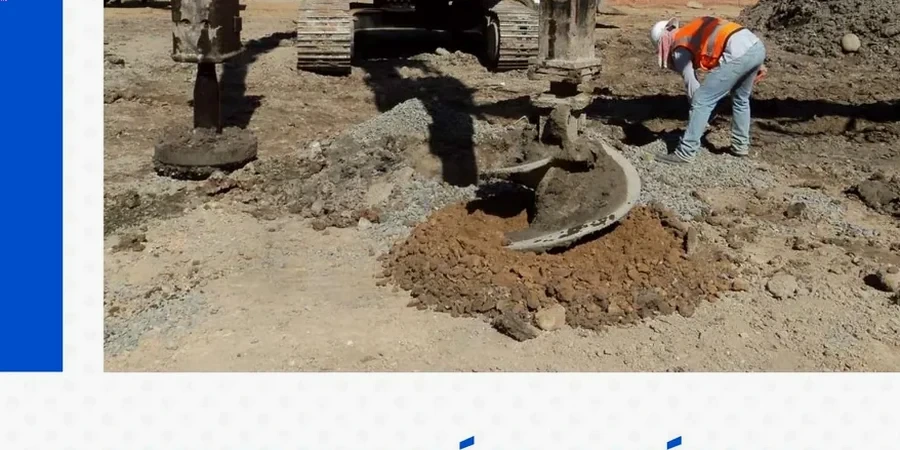
Critical ground factors in Ontario California
Ontario’s inland location shields it from the coastal moisture that complicates ground improvement in Long Beach or Santa Ana, but the seasonal swings here bring their own problem: the water table can rise eight to ten feet between October and March in the lower basin areas. A stone column design that ignores the winter high-water mark will underestimate installation effort and risk necking or incomplete compaction in the saturated zone. The Chino-Ontario subbasin has also seen decades of groundwater level fluctuation tied to recharge operations, so historical borehole water readings from summer months alone can be misleading. We always cross-check the design groundwater elevation against USGS monitoring well data and run a liquefaction triggering analysis per the Idriss-Boulanger (2014) CPT-based procedure when the site lies within the liquefaction hazard zones mapped by the California Geological Survey for San Bernardino County.
Our services
We provide two core delivery models for stone column work in Ontario, scaled to the project phase and the level of geotechnical uncertainty on site.
Design-Build Stone Column Packages
From exploratory borings through modulus verification, we handle the full design-build sequence for Ontario industrial pads and warehouse slabs. The package includes CPT and SPT profiling with our drill crew, column grid design using Priebe and unit-cell settlement analysis, and installation oversight with real-time ammeter and stone consumption logging to confirm the design assumptions hold column by column.
Third-Party Stone Column Peer Review
When the owner or the City of Ontario Building Department requests independent review of a contractor-submitted ground improvement design, we step in with a constructability-focused critique. We check area replacement ratios against CPT tip resistance profiles, verify the settlement analysis assumptions, and confirm that the column depth extends below the liquefiable layer per ASCE 7 and IBC requirements.
Questions and answers
How much does stone column design cost for a typical Ontario warehouse site?
For a standard Ontario logistics building with a footprint between 100,000 and 300,000 square feet, the combined geotechnical investigation, design calculations, and quality control plan typically falls in the range of US$1,550 to US$5,260 depending on the number of borings, depth of the soft zone, and whether CPT verification is included. Sites requiring liquefaction analysis or deeper columns above 35 feet push toward the upper end of that bracket.
How do you verify the stone columns actually work after installation?
We run post-installation CPT soundings through the center of select columns and between columns in the treated zone. The cone tip resistance and sleeve friction values get compared against the pre-design baseline, and we calculate the modulus improvement factor from the CPT data. If the column is functioning as a drain for liquefaction mitigation, we also check that the CPT pore pressure dissipation rate meets the design target.
What’s the minimum depth you need for stone columns to be effective in Ontario soils?
Stone columns generally become cost-effective once the soft or loose zone extends below about 12 to 15 feet. Shallower than that, over-excavation and recompaction often wins on cost. In Ontario’s basin areas south of the 60 freeway where the alluvium can run 25 to 45 feet deep before hitting dense Pleistocene deposits, stone columns are almost always the right call for slab support.
Does the City of Ontario require a special review for ground improvement designs?
Yes. The Ontario Building Department reviews ground improvement submittals as part of the grading and foundation permit package. They expect the design to be stamped by a California-licensed geotechnical engineer and to include settlement calculations, liquefaction analysis if the site falls within a mapped hazard zone, and a quality control plan. We prepare the full submittal package to meet their checklist and have navigated the review process on multiple Ontario industrial projects.
Can stone columns be installed right next to existing structures in Ontario?
Generally yes, but it depends on the proximity and the condition of the adjacent structure. The vibroflot generates lateral vibration that can affect sensitive utilities or poorly reinforced masonry within about 15 to 20 feet. For tight infill sites near Euclid Avenue or downtown Ontario, we run a pre-construction vibration monitoring plan and may adjust the installation sequence to start with the columns closest to the existing building, using them as a vibration barrier for the rest of the grid.