With Ontario sitting at roughly 306 meters elevation and supporting a booming logistics corridor that moves over 200,000 truck trips daily through the Inland Empire, the ground beneath every warehouse slab and distribution center floor takes a relentless beating. We see this every week on sites across the city: a structural fill that looks solid from the cab but fails the sand cone because the contractor rushed the last two lifts. The Ontario International Airport expansion zone and the vast industrial parks south of I-10 sit on alluvial soils that can vary from sandy loam to gravelly mixes within a single building pad. That is precisely why the sand cone density test remains our primary field verification tool — it gives us a direct measurement of in-place density that no nuclear gauge can match in heterogeneous fills where oversize particles skew the reading. When we test a lot near Archibald Avenue or a trench along Vineyard Avenue, we are not just punching a number on a report; we are confirming that the subgrade can handle the 4,000-psf floor loads these distribution centers demand without differential settlement showing up six months after the certificate of occupancy is issued.
A 92% compaction reading from a sand cone test in Ontario's alluvial soils means the difference between a warehouse floor that stays flat under 4,000-psf loads and one that develops 15-mm differential settlement within the first year.
Technical details of the service in Ontario California
Critical ground factors in Ontario California
The IBC 2018 (adopted by Ontario with California amendments) and ASCE 7-16 are not optional benchmarks — they establish that fill compaction verification is a code-mandated quality control step, not a contractor preference. In Ontario's seismic setting, where the city sits within 8 km of the Cucamonga Fault Zone and the probabilistic peak ground acceleration maps show values exceeding 0.5g for a 2,475-year return period, poorly compacted fill becomes a liquefaction and cyclic settlement hazard. We have documented cases on Milliken Avenue where undercompacted trench backfill, originally placed without density testing, settled over 100 mm after the 2008 Chino Hills earthquake sequence, despite the epicenter being 30 km away. The CPT test helps us identify loose zones at depth before they become a problem, but for the top 1 to 2 meters — the zone that directly supports footings and slabs — the sand cone gives us the most reliable quality assurance. Missing density testing on a single lift of structural fill in Ontario is not a shortcut; it is a latent defect that can trigger a costly repair when the first heavy forklift traffic reveals the weak spot.
Our services
Our field density testing program in Ontario covers the full compaction verification cycle, from laboratory Proctor reference curves to in-place acceptance testing and documentation for city inspectors. We typically mobilize within 24 hours of a call and can stage multiple sand cone kits when the contractor is running two or more compaction crews simultaneously.
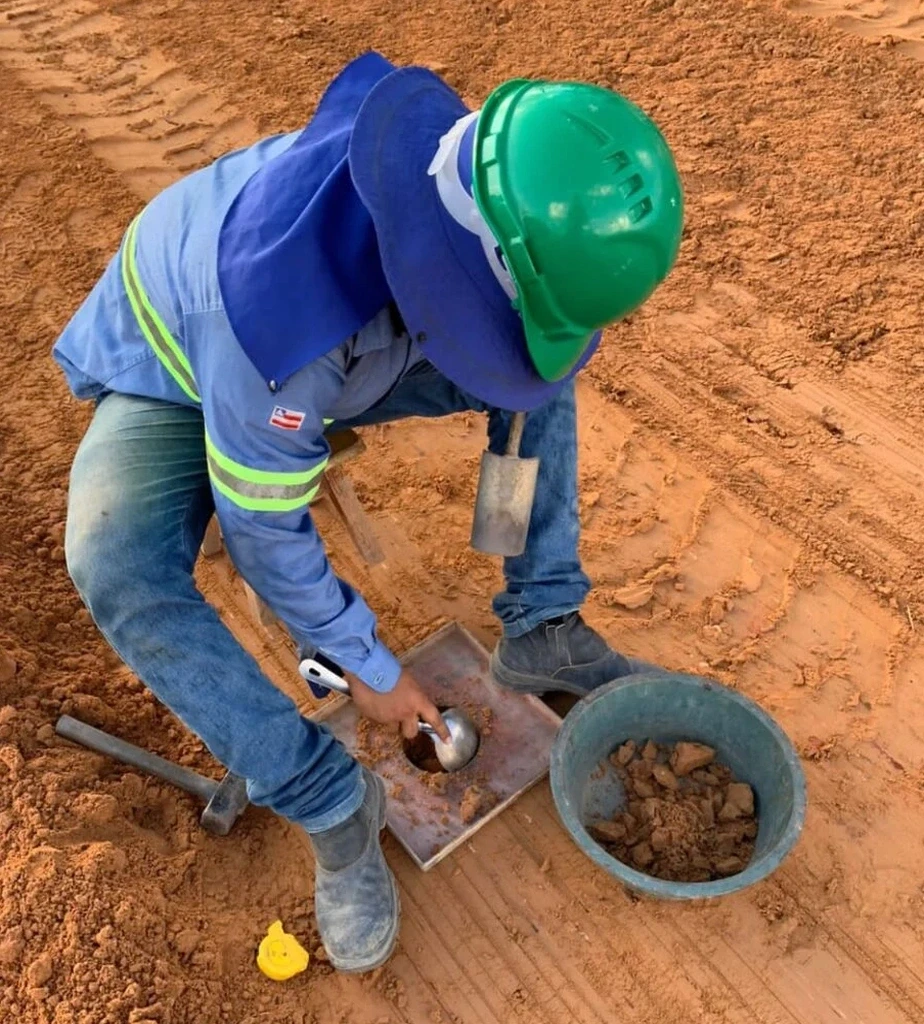
In-Place Density by Sand Cone (ASTM D1556)
Direct measurement of moist density and dry density on compacted lifts up to 150 mm thick. We provide percent compaction relative to laboratory maximum dry density, with results emailed to the project superintendent and geotechnical engineer the same day.
Laboratory Compaction Curves (Modified Proctor, ASTM D1557)
We establish the reference maximum dry density and optimum moisture content on representative fill material sourced from the Ontario site. Running the curve before field testing begins ensures the compaction spec matches the actual borrow material, not an assumed soil type.
Nuclear Gauge Correlation (ASTM D6938)
For Ontario sites with large pad areas where sand cone testing alone would slow production, we establish a site-specific correlation between nuclear moisture-density gauge readings and sand cone results on the first five lifts, then use the gauge for production testing with periodic sand cone verification.
Questions and answers
How much does a field density test using the sand cone method cost in Ontario, California?
For Ontario sites, a single sand cone density test typically ranges from US$90 to US$160 per point, depending on how many tests we run in a single mobilization day. A full-day program with 8 to 12 test locations usually falls toward the lower end of that range on a per-test basis. The price includes the field measurement, the laboratory Proctor correlation, and the stamped report.
How long does a sand cone test take on an Ontario construction site?
The field procedure for one sand cone test takes about 15 to 20 minutes from base plate placement to hole backfill. The limiting factor is usually the drying time for moisture content determination — we run the soil sample through a microwave or field oven, which adds another 20 to 30 minutes. We typically deliver the final percent compaction result to the superintendent within 60 minutes of arriving on site.
Does the City of Ontario building department require sand cone testing for residential projects?
Yes, Ontario's building department enforces the grading and fill provisions of the California Building Code (Title 24), which require compaction testing on any engineered fill placed under footings, slabs, or pavement. For single-family residential pads, the geotechnical report typically specifies one density test per lift per 2,000 square feet of pad area, or per lot, with additional tests in utility trench backfill. We coordinate directly with the city inspector to ensure the testing frequency matches the approved soils report.
What is the difference between the sand cone test and a nuclear density gauge for Ontario projects?
The sand cone method (ASTM D1556) gives a direct volume measurement by excavating and weighing soil, so it is unaffected by soil chemistry, moisture variations, or oversize particles up to 50 mm. A nuclear gauge (ASTM D6938) measures density indirectly through gamma radiation attenuation and can give erroneous readings in soils with high iron content or organic matter — conditions we occasionally encounter in Ontario's older agricultural parcels. The sand cone is slower per test but is considered the referee method when gauge readings are in dispute. On large Ontario warehouse pads, we often establish a site-specific correlation between the two methods so the contractor can use the faster gauge for production while we back-check with sand cone tests at a 1:5 ratio.