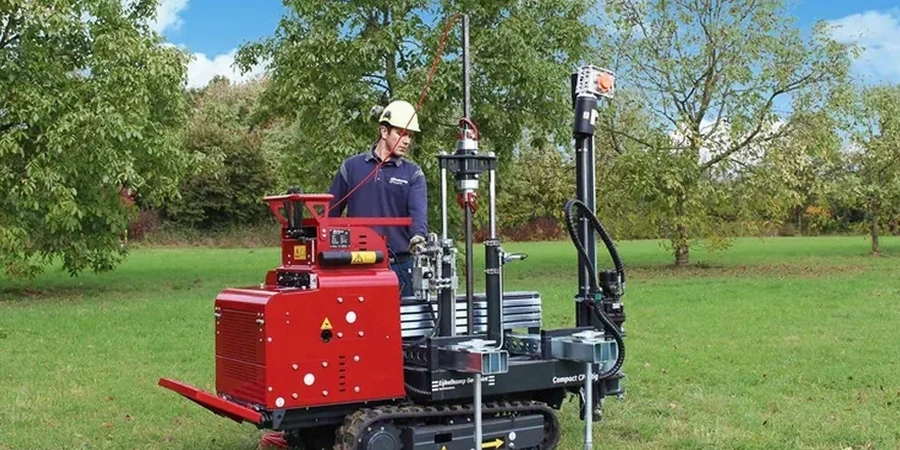
The rig arrives on site with a 20-ton hydraulic ram and a cone penetrometer tip loaded with sensors. In Ontario, our CPT truck positions over the test point and pushes the cone into the ground at a steady 2 cm per second. No borehole needed. No cuttings to manage. The cone measures tip resistance and sleeve friction every centimeter as it descends through fill, alluvium, and the deeper sediments typical of the Cucamonga basin. Data streams live to the acquisition screen in the cab. Within hours we have a continuous stratigraphic profile that shows exactly where the soft layers are. For sites near the 60 freeway or out by the airport industrial parks, this speed matters. Contractors need bearing values fast, and test pits can only go so deep before you hit water or collapse. CPT goes deeper without shoring.
CPT delivers continuous soil data at every centimeter. SPT gives you readings every 5 feet. The difference is the lens you don't miss.
Technical details of the service in Ontario California
Critical ground factors in Ontario California
Ontario sits on the southern edge of the Cucamonga fault zone, with alluvial fan deposits that vary from loose sands to stiff clays within a single building footprint. Liquefaction potential is real here. The California Geological Survey maps much of the Ontario area as having moderate to high liquefaction susceptibility, especially in the Holocene alluvium south of the 10 freeway. A CPT test gives you the continuous tip resistance and sleeve friction data needed for a liquefaction triggering analysis under ASCE 7-22. The pore pressure readings from the piezocone tell you if the soil is contractive and likely to generate excess pressure during shaking. Without this data, your geotechnical engineer is making assumptions that can lead to overdesign and unnecessary deep foundations. With CPT data, the liquefaction assessment is based on measured values, not correlations from blow counts.
Our services
Our Ontario CPT services combine field testing with interpretation engineering. We deliver more than raw data.
Seismic CPT (SCPTu)
A geophone module behind the cone measures shear wave velocity at 1-meter intervals. This gives you Vs profiles for site classification per IBC Table 1613.2.5 without a separate downhole test. Faster and cheaper than running MASW on every lot.
Liquefaction Analysis Package
We run the CPT data through established triggering procedures: Boulanger & Idriss (2014) and Robertson & Wride (1998). The deliverable includes factor of safety against liquefaction, post-liquefaction settlement, and lateral spreading displacement estimates. Ready for your structural engineer.
Questions and answers
What does a CPT test cost in Ontario, California?
CPT testing in Ontario runs US$140 to US$220 per test location depending on depth, access constraints, and whether pore pressure dissipation tests are required. A typical commercial lot investigation with 3 to 5 soundings will fall in the lower end of that range per point. Mobilization is a separate line item.
How deep can a CPT rig push in Ontario soils?
Most Ontario sites have alluvial deposits overlying older sediments. Our 20-ton truck-mounted rig reaches 60 to 80 feet in typical conditions. Refusal occurs on dense gravel or cemented hardpan. For deeper targets, we switch to mud-rotary drilling with SPT sampling.
Do I still need borings if I run CPT?
CPT provides continuous in-situ data but does not recover physical soil samples. Most projects combine CPT soundings with at least one boring to collect samples for lab classification and to confirm the CPT soil behavior type interpretation.
How fast is the turnaround on CPT data?
We provide preliminary tip resistance and friction ratio logs same-day from the field laptop. The interpreted geotechnical report with soil behavior type, strength parameters, and liquefaction analysis is delivered within 3 to 5 business days.