A common mistake in Ontario’s Inland Empire construction sector is treating base isolation as an expensive add-on rather than a fundamental design parameter, particularly for essential facilities located within 15 km of the Fontana Seismic Zone. When engineering teams skip a rigorous dynamic analysis and default to fixed-base assumptions, they underestimate the amplified ground motions that the alluvial fan sediments south of the San Gabriel Mountains can transmit. Our technical group approaches the seismic microzonation of the Cucamonga plain to define site-specific spectra before selecting isolation system parameters. This prevents the costly retrofit scenario where a newly built structure requires supplemental damping retrofits after the first moderate event reveals excessive interstory drift. Given Ontario’s population exceeding 175,000 and the rapid expansion of logistics centers near Ontario International Airport, the performance of seismically isolated structures during a maximum considered earthquake is not a hypothetical exercise—it’s a public safety requirement enforced through the local building department’s plan check process.
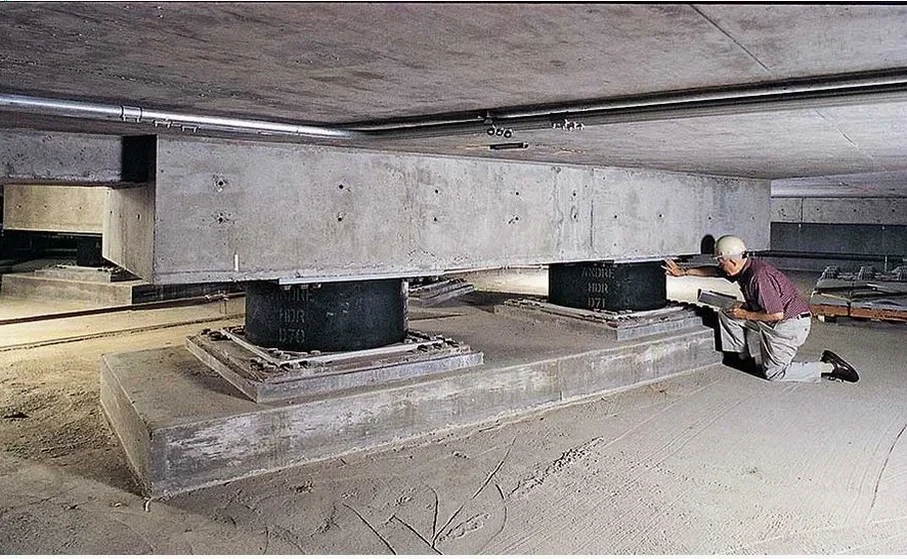
In Ontario’s near-fault environment, a properly tuned isolation system can reduce spectral accelerations by 50–70% compared to a fixed-base structure, transforming the seismic demand on non-structural components.
Technical details of the service in Ontario California
Demonstration video
Critical ground factors in Ontario California
The contrast between Ontario’s dry Mediterranean climate and the sudden co-seismic demands of a San Andreas or San Jacinto rupture creates a design condition that generic isolation catalog solutions cannot address. The hot, arid summers subject elastomeric bearings to thermal oxidation and creep, which must be factored into the long-term aging coefficients before predicting the isolator’s effective stiffness at the design displacement. A more insidious risk arises from the near-source velocity pulses—characteristic of thrust faulting within 10 km—that impose asymmetric displacement cycles on the isolation system, potentially ratcheting the structure toward the moat wall if the restoring force capacity is insufficient. When the deep excavation for the isolator pit encounters groundwater perched on the caliche lenses, the waterproofing and drainage detailing becomes critical to prevent the isolator housing from corroding over the 50-year service life of the building, a condition that the Ontario Fire Station No. 2 project team had to solve with a double-liner system and passive cathodic protection.
Our services
The base isolation package for Ontario projects extends beyond the structural analysis to include a coordinated geotechnical and testing program that validates every design assumption before the isolators arrive on site.
Nonlinear Time-History Analysis
3D finite element modeling of the isolated superstructure using site-specific ground motion suites scaled to the Ontario probabilistic hazard curves, including directivity effects from the Fontana segment.
Isolator Pre-Installation Testing
Full-scale quality control testing of lead-rubber and friction pendulum bearings at an ISO 17025 accredited laboratory, verifying effective stiffness and damping at three displacement amplitudes per ASCE 7 cycle requirements.
Construction Phase Monitoring
Continuous survey and strain monitoring during isolator installation and upper diaphragm casting, ensuring that the initial displacement offset does not exceed 0.25 in before the structure is released.
Questions and answers
What is the typical cost range for a base isolation design package for a new building in Ontario?
The engineering fee for a complete base isolation design—including nonlinear time-history analysis, isolator specification, prototype testing oversight, and construction administration—ranges from US$3,610 to US$7,310 for a commercial or institutional project in Ontario. The final cost depends on the number of isolation units, the complexity of the superstructure, and the number of ground motion pairs required for the peer review panel.
How does ASCE 7-22 define the required isolator testing protocol before installation?
ASCE 7-22 Section 17.8 mandates that at least two full-scale isolator prototypes be tested to the maximum considered earthquake (MCEᵣ) displacement for three full cycles, preceded by wind and service-level cycles. The effective stiffness and equivalent viscous damping at each displacement level must fall within ±15% of the nominal design values, and the isolator must demonstrate stable hysteresis without strength degradation.
What site investigation scope does the Ontario Building Department require for a base-isolated structure?
The Ontario plan check typically requires a geotechnical report that includes a shear wave velocity profile to 100 ft depth (for Site Class determination), a liquefaction potential evaluation using SPT or CPT data, and a site-specific response spectrum analysis that accounts for near-source effects. We coordinate the seismic refraction and downhole testing to satisfy these requirements before the isolation system parameters are finalized.
Can an existing Ontario building be retrofitted with base isolation while remaining occupied?
Yes, seismic isolation retrofits have been successfully executed in occupied buildings, though the logistics in Ontario’s commercial corridors require careful phasing. The process involves installing temporary jacking columns and load transfer beams at the foundation level, cutting the existing columns in sequence, and inserting the isolators one bay at a time. A detailed construction sequence analysis must verify that the temporary lateral system can resist the reduced-level earthquake forces during the staged installation.