Last year we reviewed plans for a tilt-up warehouse off Vineyard Avenue where the developer assumed a standard slab-on-grade would suffice. Ontario sits on a mix of recent alluvium and older terrace deposits — the soils shift from sandy loam to clay within half a mile. The geotech report flagged moderate expansion potential and a water table that fluctuates with the Cucamonga Basin recharge cycles. Instead of isolated footings that would have required deep overexcavation, the structural engineer switched to a mat foundation. That single decision cut the foundation schedule by three weeks and eliminated the need for imported select fill. Raft/mat foundation design works because it distributes column loads across the entire footprint, bridging soft spots without excessive differential settlement. When the subgrade has variable stiffness — and in Ontario it often does, especially near the old agricultural parcels south of the 60 — a unified slab keeps everything moving together. We run the soil-structure interaction models using site-specific modulus of subgrade reaction values derived from field plate load tests and SPT borings, so the reinforcement layout reflects real bearing conditions, not textbook assumptions. For projects near the Ontario International Airport flight path overlay, where vibration sensitivity matters, this integrated approach provides a measurable improvement over isolated footings on disturbed ground.
In Ontario's alluvial soils, a well-designed mat foundation turns variable subgrade into a predictable bearing surface — without overexcavation.
Technical details of the service in Ontario California
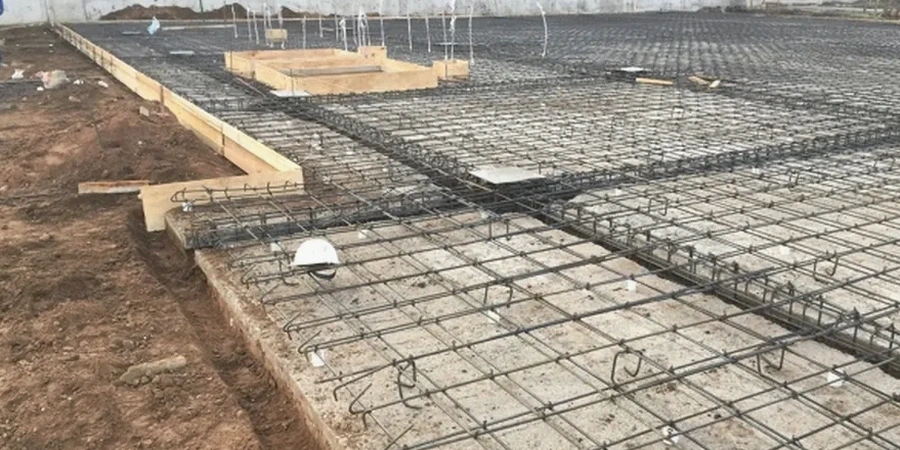
Critical ground factors in Ontario California
A mistake we encounter repeatedly in Ontario is treating a mat foundation like a thickened slab designed by rule of thumb. A contractor pours a 12-inch uniform slab with a single layer of #4 bars at 18 inches on center, no drop panels at columns, no thickened edges, and no subgrade preparation beyond a quick pass with a plate compactor. The building goes up, the first wet season arrives, and within eight months the slab corners start curling and the column lines show hairline cracking at the partition walls. By month eighteen, door frames bind and drywall tape separates at the ceiling grid. The root cause is almost always the same: no geotechnical input, no modulus of subgrade reaction testing, and no differential settlement analysis. In Ontario's expansive clay zones — particularly in the neighborhoods east of Archibald Avenue — edge heave can lift a poorly reinforced slab by half an inch over two seasons. Retrofitting slab underpinings or injecting polyurethane foam after occupancy costs five to ten times what proper raft/mat foundation design would have cost at permit stage. The IBC-required geotechnical report is not a checkbox — it provides the bearing values and heave potential that dictate reinforcement detailing, joint layout, and sub-drain design.
Our services
Our raft/mat foundation design work in Ontario covers the full process from subgrade investigation through reinforcement detailing and construction-phase consultation. Each project starts with site-specific geotechnical data — without it, the structural model has no legs.
Geotechnical Investigation & Testing
We execute SPT borings, plate load tests, and laboratory consolidation and expansion index tests to determine in-situ bearing capacity, modulus of subgrade reaction, and heave potential per IBC 1803. This data feeds directly into the mat design model.
Soil-Structure Interaction Modeling
Using finite element software, we model the raft as an elastic plate on Winkler springs calibrated to field-derived kₛ values. The analysis captures differential settlement, moment distribution, and punching shear at column locations for irregular building footprints common in warehouse and industrial construction.
Reinforcement & Detailing Plans
We produce stamped drawings showing mat thickness, top and bottom reinforcement layout, drop panels, thickened edges, and construction joint details. All reinforcement complies with ACI 318-19 and the structural engineer's column load schedule.
Construction-Phase Observation
During excavation and subgrade preparation, we verify that bearing materials match the geotechnical report assumptions. We observe reinforcement placement, moisture barrier installation, and perimeter drainage before the concrete pour.
Questions and answers
How much does a raft/mat foundation design cost for a commercial building in Ontario?
For a typical commercial or warehouse building in Ontario, the geotechnical investigation plus structural design package for a mat foundation runs between US$1,150 and US$4,490. The range depends on building footprint size, number of borings required, and whether plate load testing is needed to calibrate the modulus of subgrade reaction. Projects under 5,000 square feet with straightforward soil profiles tend toward the lower end; larger footprints with variable subgrade conditions and seismic Site Class D analysis push toward the upper end.
When is a mat foundation preferable to isolated footings in Ontario?
A raft/mat foundation makes sense when the bearing stratum is variable across the site, the allowable soil bearing pressure is below 2,500 psf, or the structural engineer wants to eliminate differential settlement between columns. In Ontario, this frequently applies to warehouse and tilt-up construction where the column grid covers a large footprint and the soils transition from sandy alluvium to expansive clay within the building pad. Mats also perform better seismically because the monolithic slab ties the entire structure together, reducing relative displacement between columns during a lateral loading event.
What subgrade preparation does a mat foundation require in Ontario's soils?
Subgrade preparation starts with stripping organic material and any undocumented fill. We then proof-roll the exposed subgrade and verify compaction to at least 95% of modified Proctor density per ASTM D1557. In Ontario's expansive clay zones, we typically specify a moisture-conditioned subgrade, a capillary break layer of clean aggregate, and a vapor barrier placed directly beneath the slab. Perimeter under-slab drainage is critical — without it, water migrating beneath the mat can trigger edge heave during the wet season and cause the slab corners to lift. More info.