Ontario’s transformation from a citrus-growing colony into a major logistics hub has placed unprecedented structural demands on its underlying geology. The city sits on the alluvial fan of the Cucamonga Creek, where subsurface conditions can shift dramatically within a single parcel — from dense sands to compressible silts deposited by historic floodplain activity. When we conduct an SPT drilling program here, we are not just counting blows; we are mapping the depositional energy of the fan to anticipate differential settlement before the first footing is poured. Our field teams routinely encounter the interface between young Quaternary alluvium and older cemented formations, a transition that governs both bearing capacity and excavation stability in Ontario’s industrial developments. This variability makes a methodical SPT investigation essential for compliance with the ASCE 7 seismic provisions that apply throughout western San Bernardino County.
In Ontario's alluvial fan deposits, a five-foot change in depth can mean the difference between loose silty sand and dense cemented gravel — SPT data bridges that uncertainty.
Technical details of the service in Ontario California
Critical ground factors in Ontario California
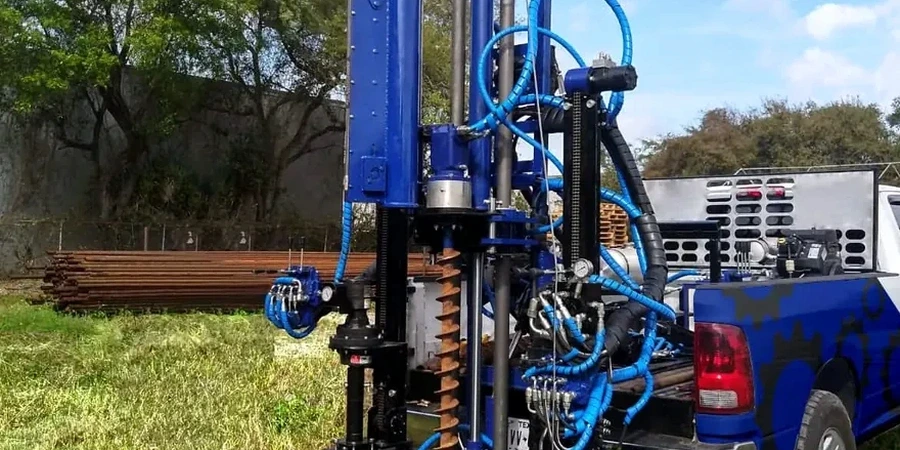
Our drill rigs in Ontario are configured with automatic trip hammers calibrated to a measured energy ratio — a critical detail that separates code-compliant data from rough estimates. When the hammer trips and the rope turns, the energy delivered to the split-spoon sampler must be consistent with the ASTM D1586 standard, otherwise the raw N-values are meaningless for liquefaction triggering analysis. The biggest risk we see in Ontario projects is contractors accepting uncorrected field N-values from uncalibrated equipment, leading to overly optimistic bearing capacity assumptions. With groundwater depths in the Ontario Basin often shallower than 30 feet, the saturated silty sands that dominate the lower alluvial sequence are prime candidates for cyclic softening under the design earthquake specified in ASCE 7-22. A properly executed SPT program, with N60 corrections and fines content verification from parallel CPT testing in critical areas, is the only way to generate a defensible liquefaction assessment for the city's building department review.
Our services
Our Ontario geotechnical services combine SPT data with complementary field and laboratory programs to deliver a complete subsurface model suitable for foundation engineers, structural designers, and grading contractors.
SPT-Based Foundation Recommendations
We translate SPT blow counts into allowable bearing pressures and estimated settlements for shallow footings and mat foundations, following the empirical methods established by Terzaghi, Peck, and Meyerhof, adjusted for the granular alluvial soils prevalent in Ontario.
Seismic Site Classification & Liquefaction Screening
Using the corrected N60 profile from SPT boreholes, we assign the IBC seismic site class (C, D, or E) and perform liquefaction potential evaluation using the Seed & Idriss simplified procedure, incorporating fines content from laboratory testing to refine cyclic resistance ratios.
Questions and answers
How much does SPT testing cost for a typical Ontario warehouse project?
For a standard commercial project in Ontario, an SPT investigation with three boreholes extending to 40–50 feet depth, including the drill rig, operator, and geotechnical report, ranges from US$560 to US$660 per borehole depending on access conditions and the presence of cobbles. Mobilization fees and traffic control on busy corridors like Milliken Avenue add to the total, but we provide a fixed-fee proposal after reviewing your site plan.
How many SPT boreholes does the City of Ontario require for a new building?
The Ontario Building Department follows IBC Chapter 18, which mandates a minimum of one borehole for every 2,500 square feet of building footprint for structures on unknown fill or alluvial soils. For a typical tilt-up warehouse of 100,000 square feet, we typically recommend a grid of six to eight SPT borings to capture the lateral variability of the Cucamonga alluvial fan deposits and satisfy the geotechnical peer review often required for large industrial projects.
What depth should SPT boreholes reach in Ontario soil conditions?
We generally extend SPT boreholes to a depth where the stress increase from the foundation load is less than 10% of the in-situ effective stress, which in Ontario's alluvial basin typically falls between 40 and 60 feet for single-story warehouses. However, if the preliminary logs indicate loose sands below the groundwater table at 25 to 30 feet, we deepen the borings to at least 60 feet to fully characterize the liquefiable stratum per ASCE 7-22 requirements.
How do you correct SPT N-values for energy efficiency and overburden pressure?
We measure the hammer energy ratio on our CME automatic trip hammers using load cell instrumentation following ASTM D4633, typically obtaining ER values between 70% and 85%. The raw N-value is then normalized to N60, and further corrected for overburden pressure using the Liao & Whitman method to obtain (N1)60. These corrected values are the input for all our bearing capacity equations and cyclic resistance ratio calculations for liquefaction assessment.
What happens if you hit refusal during SPT drilling in Ontario?
Refusal — defined as 50 blows over less than 6 inches of penetration — is common in Ontario's northern foothill areas where Holocene gravels contain cobbles derived from the San Gabriel Mountains. When this occurs, we log the refusal depth and switch to rock coring with an NQ or HQ core barrel if the project requires deeper characterization. For foundation design, we report the refusal depth and classify the material as practically non-liquefiable and capable of high bearing pressures, though we verify with a larger-diameter bucket auger or test pit if precise allowable values are needed.