The alluvial fans spreading from the San Gabriel and San Bernardino foothills give Ontario a deceptive surface geology. You see flat, buildable land, but just below the topsoil, permeability can swing wildly between clean sandy gravels from past flood events and tighter silty lenses from old playa deposits. For any excavation deeper than ten feet or any stormwater infiltration design, guessing at the mass permeability is a budget risk. We run the Lefranc test in boreholes to isolate discrete zones within these heterogeneous profiles, providing the k-value data that dewatering contractors and geotechnical modelers actually need. When rock is encountered in the deeper foothill margins near the I-15 corridor, we switch to the Lugeon method to quantify fracture flow, which directly informs grouting take estimates and cutoff wall specifications.
A single Lugeon test in fractured granodiorite tells you more about grout consumption than a hundred lab permeability tests on intact core.
Technical details of the service in Ontario California
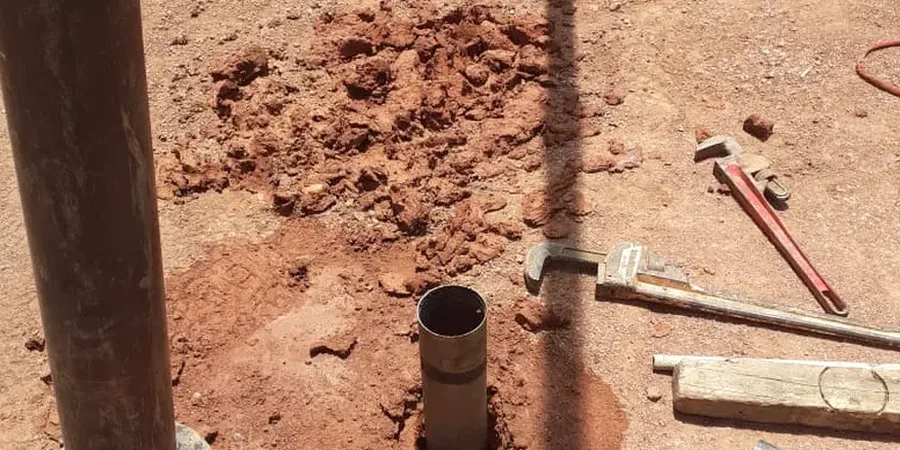
Critical ground factors in Ontario California
A 25-foot excavation for a stormwater retention basin near the Ontario Ranch area hit an unexpected openwork gravel layer at 18 feet. The contractor had based pump sizing on a regional desktop study, but the actual inflow was triple the estimate. Within two hours, the excavation walls started sloughing and the adjacent access road developed tension cracks. A quick deployment of a variable-head Lefranc test in our exploratory boring revealed a k-value over 1 cm/s in that thin layer, something a standard SPT sampler completely missed because the gravel simply fell out of the spoon. We recalibrated the dewatering plan overnight, adding deep wells with screened intervals targeting just that high-permeability zone. The lesson in Ontario's alluvial setting: a single zone with high hydraulic conductivity can control the entire excavation stability, and you will not know it is there without a zoned in-situ test.
Our services
Our Ontario field team runs these tests as part of comprehensive geotechnical investigations, tailored to the specific demands of the Inland Empire's soil and rock conditions.
Variable & Constant Head Lefranc
Borehole permeability testing in soil above the water table or in the saturated zone, using either falling or constant head methods depending on the formation's expected transmissivity.
Multi-Stage Lugeon Testing
Five-pressure-step packer tests in fractured rock to assess the hydraulic aperture of joints, detect dilation or infilling behavior, and calculate the Lugeon value for grouting design.
Dewatering Feasibility & Design Input
Integration of in-situ k-values with CPT and SPT data to generate the hydraulic parameters required for MODFLOW modeling, well point spacing, and sump sizing in Ontario's layered alluvium.
Questions and answers
How much does a field permeability test cost in Ontario, CA?
For a single Lefranc test performed in an accessible borehole, budget between US$560 and US$1,110. The final figure depends on whether we are already mobilizing a drill rig for other SPT or sampling work, and on the depth and number of test intervals. A full Lugeon profile in rock runs higher due to the packer setup and multi-pressure stage time, but sharing mobilization with a geotechnical investigation always reduces the per-test cost.
When is a Lugeon test required instead of a Lefranc test?
We use Lugeon testing whenever the project encounters rock that is fractured, or when the design involves pressure grouting, cutoff curtains, or tunnels. The Lugeon method isolates a specific section of the borehole with a packer and applies water at controlled pressures, measuring the flow rate in Lugeon units (liters per meter per minute at 1 MPa). In Ontario's foothill areas, this is essential for dams, deep shafts, or any structure where rock mass permeability governs the design.
Can you run these tests in existing monitoring wells?
We can perform rising or falling head slug tests in existing wells, but for new construction projects in Ontario we strongly prefer to perform Lefranc tests during the initial geotechnical drilling phase. Existing wells often have a filter pack that smears the true formation response, and you lose the ability to test discrete, isolated zones. A dedicated Lefranc test in an open borehole, before casing installation, gives a far more reliable k-value for dewatering design.