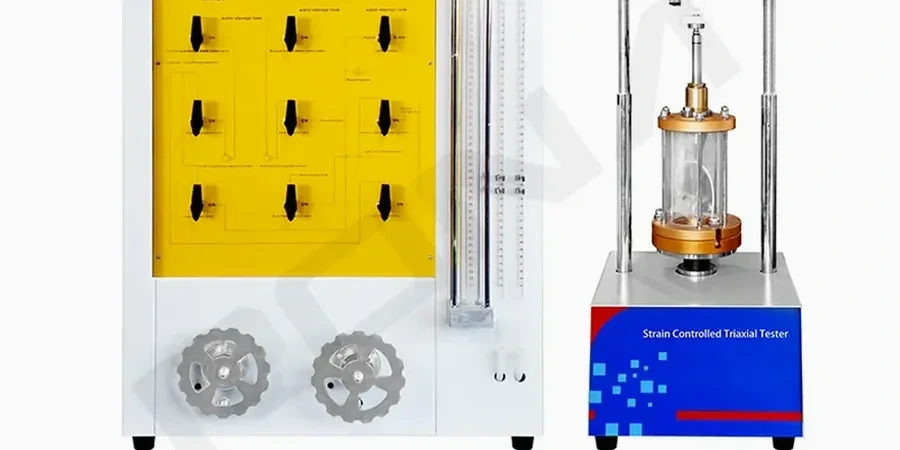
A triaxial cell sitting in our Ontario lab runs through its loading sequence while a digital data logger records every pore pressure fluctuation and axial strain increment at 0.001 mm resolution. The setup includes a Bishop & Wesley-type cell with double drainage lines, a 10,000 psi capacity load frame, and three independent pressure controllers that maintain confining pressures up to 1,500 psi—more than enough for the deep alluvial deposits and occasional cemented conglomerate lenses found across the Cucamonga Plain. Samples arrive from commercial developments near Ontario Mills, warehouse foundations off Vineyard Avenue, and infrastructure projects along the I-10 corridor, each sealed with wax to preserve field moisture. Before any stage loading begins, we back-saturate every specimen to a B-value exceeding 0.95 and run a minimum of three effective confining stress levels to bracket the in-situ overburden range. The CPT test often provides the preliminary stratigraphy and in-situ state parameters, while a full grain size analysis confirms the fines content that dictates whether we run consolidated-undrained with pore pressure measurement or a drained test with volume change recording.
Triaxial testing under site-specific confining pressures reveals whether an Ontario soil dilates or contracts at working loads—a distinction that SPT blow counts alone cannot resolve.
Technical details of the service in Ontario California
Demonstration video
Critical ground factors in Ontario California
With Ontario's population now exceeding 180,000 and warehouse/logistics construction continuing at record pace across the former agricultural parcels south of the 60 freeway, the margin for geotechnical uncertainty has narrowed considerably. ASCE 7-22 design ground motions for this latitude and longitude produce short-period spectral accelerations that demand reliable undrained shear strength data for any liquefaction assessment beyond simplified SPT-based triggering curves. A single set of unconfined compression tests on silty clay from the upper 10 feet will miss the drained friction angle entirely and overestimate cohesion intercepts that disappear under sustained loading. The real consequence shows up when a retaining wall designed with φ=28° from a pocket penetrometer actually operates at φ=22° effective after pore pressure equalization—and the wall rotates. Triaxial testing with pore pressure measurement eliminates that gap, providing the effective stress strength envelope that governs long-term stability of retaining walls and braced excavations in the Inland Empire's interbedded alluvial profile.
Our services
Our triaxial testing program in Ontario is structured to support foundation engineers, structural designers, and numerical modelers who need more than index property correlations. Each test program is designed around the specific loading conditions and drainage boundaries of the project.
Consolidated-Undrained Triaxial (CU with pore pressure)
Saturated undisturbed specimens tested at three effective confining stresses with continuous pore pressure measurement, yielding the effective stress Mohr-Coulomb envelope (c', φ') and Skempton's A parameter at failure. Essential for short-term stability analysis of excavations and embankment construction on Ontario's fine-grained alluvium.
Consolidated-Drained Triaxial (CD)
Slow-strain-rate testing with volume change measurement on sands and granular fills, providing the drained friction angle φ' at peak and critical state. Used for long-term bearing capacity and slope stability where excess pore pressures have fully dissipated.
Constitutive Model Parameter Calibration
Multi-stage triaxial testing with unload-reload loops at each confining stress to extract the secant modulus E50, oedometric tangent stiffness Eoed, and power-law exponent m for the Hardening Soil model. Direct input for Plaxis 2D/3D and FLAC analyses of deep excavations and tunnel linings.
Questions and answers
When does an Ontario project need a triaxial test instead of just running SPT or direct shear?
Triaxial testing becomes necessary whenever pore pressure development during loading affects stability—and that includes most saturated fine-grained soils below the water table in Ontario's alluvial basin. The SPT gives you N-values for empirical correlations, and direct shear forces failure on a predetermined horizontal plane. Neither captures the effective stress path nor the contractive/dilative behavior that controls whether a silty sand layer at 35 feet depth will lose strength during a seismic event. If your project involves braced excavations deeper than 15 feet, mat foundations on compressible clay, or any structure in Seismic Design Category D, the triaxial test provides the drained and undrained strength parameters that Plaxis and FLAC models actually need.
What is the typical turnaround time for a triaxial testing program in the Inland Empire?
A standard three-specimen CU triaxial program on undisturbed samples takes approximately 10 to 14 business days from sample extrusion to the final report. The timeline breaks down into specimen preparation and saturation (2-3 days), consolidation at each confining stress (24-48 hours depending on soil permeability), and the shearing stage at the specified strain rate (1-3 days per specimen). Consolidated-drained tests on sands run faster—typically 5 to 7 days total—because drainage occurs more rapidly. Rush processing can compress the schedule to 7 days when project deadlines require it. We always coordinate with the drilling crew to ensure Shelby tubes arrive within 48 hours of extraction so sample disturbance remains minimal.
What does triaxial testing cost for a typical commercial building project in Ontario?
A complete triaxial testing program for a commercial project in Ontario typically runs between US$2,030 and US$3,070, depending on the number of specimens, confining stress levels, and whether you need CU, CD, or both. A three-specimen CU program with pore pressure measurement on undisturbed samples falls toward the middle of that range. Adding consolidated-drained tests on granular fill or running multi-stage tests with unload-reload loops for constitutive model calibration moves the cost toward the upper end. The investment represents a fraction of the foundation cost and eliminates the risk of designing with overly conservative—or unconservative—correlation-based strength parameters.