Ontario's transformation from a citrus-growing colony to a major logistics hub in the Inland Empire placed extraordinary demands on its pavement infrastructure. The city sits at 1,000 feet elevation on the Cucamonga Plain, where Quaternary alluvium derived from the San Gabriel Mountains creates a heterogeneous subgrade of sands, silts, and occasional gravel lenses. For the heavy truck corridors serving Ontario International Airport and the intermodal rail yards, rigid pavement design becomes the only viable solution when fatigue life under repeated axle loads is the controlling factor. Portland cement concrete slabs distribute stress across a wide footprint, but their performance depends entirely on how the underlying soil responds to seasonal moisture fluctuations and seismic events. A CBR road study quantifies the bearing capacity of the native formation, while grain size analysis identifies the proportion of fines that could pump at slab joints.
In Ontario's logistics corridors, a rigid pavement design is only as reliable as the subgrade support beneath it—k-value and drainage dictate slab longevity far more than concrete strength.
Technical details of the service in Ontario California
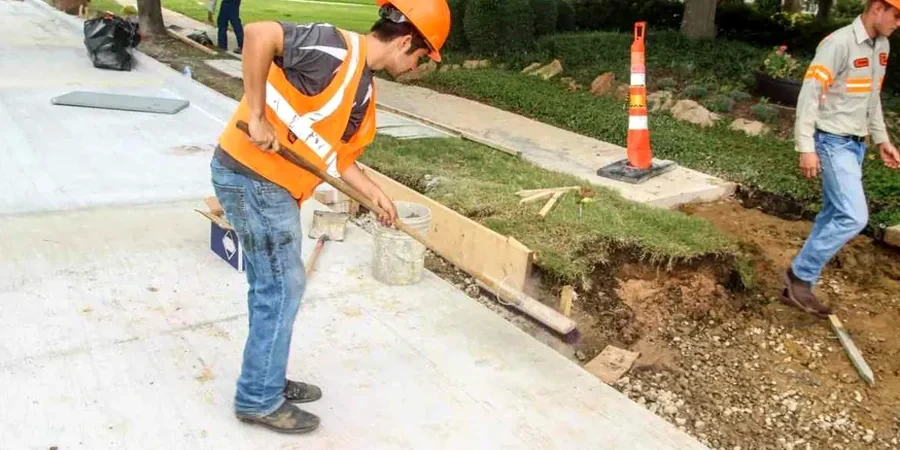
Critical ground factors in Ontario California
The most costly mistake we see in Ontario's industrial parks is designing rigid pavement on silty subgrades without addressing pumping potential. When a loaded semi-trailer crosses a joint, slab deflection forces water and fines upward through the joint opening, eroding the base layer within months. The California Department of Transportation documented this mechanism extensively in the I-10 corridor, where early jointed plain concrete pavements failed prematurely despite meeting compressive strength specifications. A proper investigation starts with in-situ permeability testing to evaluate whether the formation drains freely or retains water under the slab. In Ontario's semi-arid climate with 15 inches of annual rainfall concentrated in winter months, drainage design and non-erodible base layers become just as critical as the concrete mix itself.
Our services
Our rigid pavement design services for Ontario projects integrate geotechnical investigation with structural analysis, ensuring the slab system performs under the combined effects of heavy logistics traffic and Inland Empire climatic conditions.
Subgrade Evaluation & k-Value Determination
Field plate load tests and SPT borings to establish the modulus of subgrade reaction, with laboratory classification per ASTM D2487 for Ontario's alluvial fan deposits.
Pavement Thickness & Joint Design
Westergaard-based analysis for corner, edge, and interior loading conditions, with joint layout optimization for thermal movement and seismic joint activation in Ontario's Site Class D profiles.
Base & Drainage System Specification
Design of cement-treated or permeable bases with edge drains to prevent pumping in silty subgrades, calibrated to Ontario's 15-inch annual rainfall and winter concentration patterns.
Questions and answers
What is the typical cost range for a rigid pavement design study in Ontario, CA?
For industrial and commercial projects in Ontario, a complete rigid pavement design package—including subgrade investigation, k-value determination, and slab thickness analysis—typically ranges from US$1,890 to US$7,120. The final fee depends on the pavement area, number of borings required, and whether specialized testing such as plate load or permeability is needed.
Which subgrade conditions in Ontario make rigid pavement preferable to flexible?
Rigid pavement becomes the preferred option when the subgrade is weak and variable, as in the alluvial deposits of the Cucamonga Plain, or when heavy static loads from parked trailers create rutting in asphalt. Ontario's logistics facilities with concentrated loading docks and container yards benefit from the stress-distributing capacity of concrete slabs, which reduce pressure on the subgrade by a factor of 20 to 30 compared to flexible pavement.
How does seismic activity in the Inland Empire affect rigid pavement design?
The proximity to the San Andreas and San Jacinto fault zones means Ontario pavements must accommodate differential movement at joints during seismic events. We design dowel bars and tie bars to maintain load transfer efficiency under the peak ground acceleration specified in ASCE 7-22 for the site, and we detail isolation joints where slabs abut buildings or rigid utilities to prevent structural damage.
What laboratory tests are essential for Ontario rigid pavement concrete mix design?
Beyond standard compressive strength tests, we specify third-point flexural beam testing to determine the modulus of rupture at 28 days. For Ontario's semi-arid conditions, shrinkage testing per ASTM C157 is critical to predict early-age cracking risk. When sulfate-resistant cement is required due to soil chemistry in certain Ontario formations, we verify compliance through chemical analysis of soil and groundwater samples.