Ontario sits at roughly 735 feet above sea level, perched on the massive alluvial fan that drains the San Gabriel Mountains into the Chino Basin — and that geology creates a hidden puzzle for every contractor who breaks ground here. Layers of coarse sand, gravel stringers, and fine silts shift dramatically across a single parcel, making traditional drilling alone an incomplete picture. Our electrical resistivity testing cuts through that uncertainty by mapping how current flows through the subsurface, identifying transitions between granular and cohesive deposits before the first excavator arrives. For projects near the 60 freeway corridor or the expanding industrial zones around Ontario Ranch, this non-invasive method reveals depth to bedrock, perched water tables, and even saline intrusion that could corrode buried utilities. When you combine resistivity profiles with a CPT test for precise cone resistance data, you get a stratigraphic model that holds up under contractor scrutiny and plan-check review.
Resistivity profiling in the Chino Basin alluvium often reveals perched water and paleochannel boundaries that boreholes spaced 50 feet apart would completely miss.
Technical details of the service in Ontario California
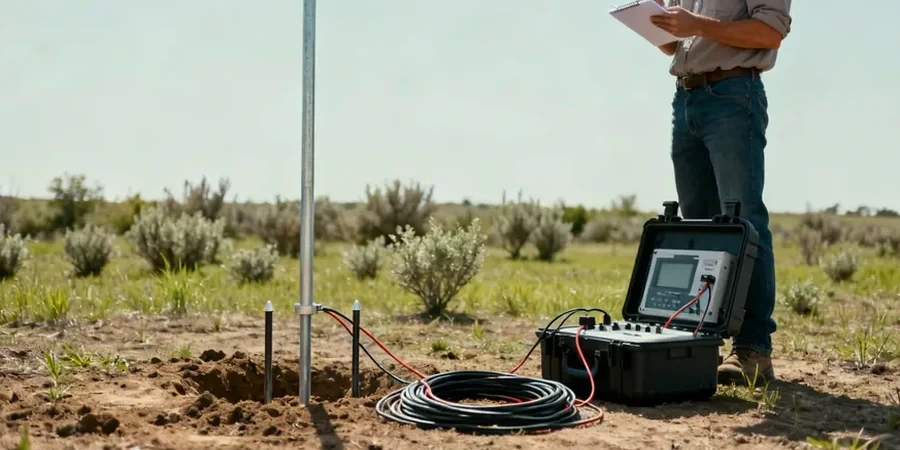
Critical ground factors in Ontario California
Ontario’s transformation from a citrus-growing valley to a logistics powerhouse brought rapid grading across relict stream channels and buried paleochannels that don’t appear on any USGS quad. Those hidden features — old washes filled with loose, saturated sand — create differential settlement paths that can crack slabs and rack steel frames within the first five years. The city’s location within the Chino Groundwater Basin also means subsurface water chemistry varies block by block; high dissolved solids in certain zones accelerate sulfate attack on concrete, while perched water lenses trapped above clay lenses mislead contractors who rely on borehole observations alone. A geophysical survey using vertical electrical sounding catches these contrasts early, because resistivity drops sharply when you transition from dry alluvium into a saline or clay-rich layer — a signal that a single boring might miss entirely. The result is a more complete risk map that helps structural engineers decide where to deepen footings and where a mat foundation might be the safer call.
Our services
Our electrical resistivity services for Ontario projects are designed to integrate directly with your geotechnical investigation workflow, providing actionable subsurface data without adding weeks to the schedule.
2D Electrical Resistivity Imaging (ERI)
A multi-electrode survey that produces a continuous cross-section of subsurface resistivity, ideal for mapping lithologic contacts, groundwater table depth, and buried channel geometry beneath proposed building pads or retention basins in the Ontario Ranch area.
Vertical Electrical Sounding (VES)
A point-depth sounding method using expanding electrode spreads that quantifies layer resistivity and thickness at a single location — especially useful for estimating depth to bedrock or assessing soil corrosivity for utility corridors crossing the Chino Basin.
Questions and answers
How much does an electrical resistivity survey cost for a typical Ontario commercial lot?
Most surveys on commercial parcels in Ontario range from US$590 to US$1,120, depending on the array length, number of soundings, and whether 2D imaging or single-point VES is required. Larger spreads or difficult access conditions may push toward the upper end.
What subsurface conditions in Ontario can resistivity testing identify that drilling might miss?
Resistivity excels at detecting lateral changes between boreholes — paleochannel boundaries, perched water lenses, and zones of high salinity or clay content — that a standard boring program with 50-foot spacing can overlook in the heterogeneous alluvial fan deposits underlying Ontario.
Does the City of Ontario accept geophysical data as part of the geotechnical report for plan check?
Yes. Ontario plan check engineers review geophysical data as supplementary investigation under IBC Chapter 18, particularly when it supports interpretations of soil variability, groundwater depth, or corrosion potential. The data must be presented alongside direct borings or CPT soundings for calibration.
How long does a typical resistivity survey take on site?
A standard 2D resistivity line with 200 feet of spread and 10-foot electrode spacing can be acquired in approximately two to three hours, including setup and breakdown. Multiple lines or deeper soundings may require a full day, but the method is significantly faster than mobilizing a drill rig for the same lateral coverage.