Much of Ontario California sits on Quaternary alluvium washed down from the San Gabriel and San Bernardino Mountains — a mix of sands, silts, and lean clays that can behave very differently once exposed to water. Our lab routinely sees fines content ranging from 15% to over 60% in samples pulled from the Cucamonga Basin, which makes Atterberg limits testing essential before any grading or foundation design. A routine grain-size test tells you the sand-silt split, but it says nothing about how the fines react to moisture, and that is where the plastic behavior matters. In a city that recorded a 5.5% population jump between 2020 and 2023, the pressure to build on marginal parcels means you cannot guess the clay fraction’s shrink-swell potential.
A plasticity index above 20 in Ontario’s basin clays almost always means we recommend lime treatment before structural fill placement.
Technical details of the service in Ontario California
Demonstration video
Critical ground factors in Ontario California
The 2022 California Building Code (Chapter 18) ties allowable foundation pressures directly to soil classification, and in Ontario California the risk is not just differential settlement — it is the seasonal volume change in the A-horizon clays. We have pulled samples in late summer that crumbled dry and gave a PL of 17, then retested the same formation in February after three inches of rain and found the LL jumped by eight points. If the PI is underestimated, a lightly loaded slab-on-grade can heave enough to crack partition walls within two wet seasons. IBC Section 1803.5.3 requires classification of fine-grained soils by Atterberg limits on every project where clay seams are present, and skipping that step because “the soil looked sandy” has caused at least two slab replacements we know of in the Ontario Ranch specific plan area.
Our services
We run the full suite of index testing under one roof so you are not waiting on three different labs. Every report includes the plasticity chart with the A-line and U-line plotted, plus moisture content and the liquidity index when undisturbed strength data is available.
Atterberg Limits (ASTM D4318)
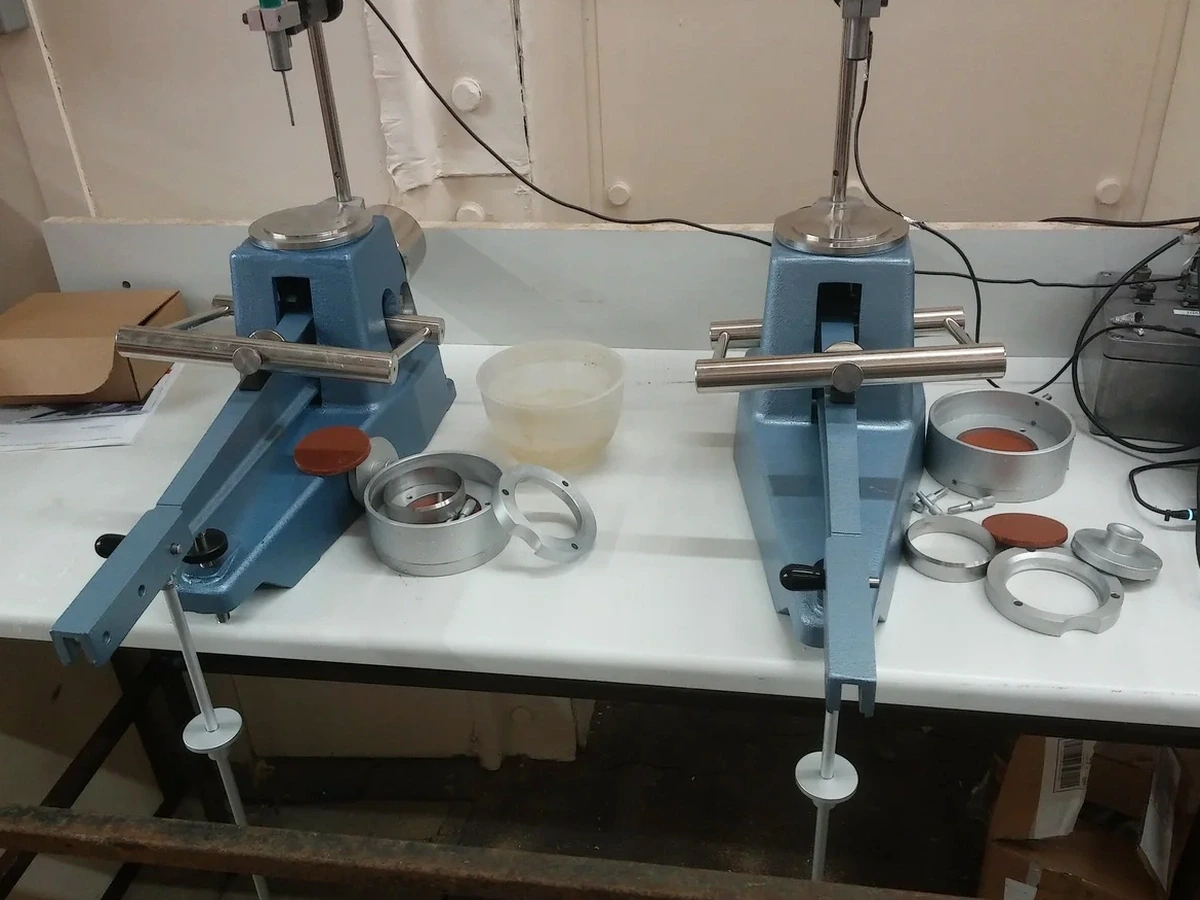
Liquid limit by Casagrande cup, plastic limit by hand-rolling, and calculated plasticity index with USCS symbol assignment.
One-Point Liquid Limit
Correlation method for routine quality control on projects with established regional soil correlations, validated against multi-point baseline tests.
Shrinkage Limit & Linear Shrinkage
Complementary index testing for highly plastic clays where volume-change potential needs quantification beyond the PI alone.
Questions and answers
What is the typical cost for Atterberg limits testing in Ontario?
A standard multi-point Atterberg limits test with liquid limit, plastic limit, and plasticity index report typically runs between US$60 and US$110 per specimen, depending on the number of points and whether the sample requires extended soaking for fat clays.
How many pounds of soil do you need to run the test?
We ask for at least one pound of material passing the No. 40 sieve. If the sample is predominantly fine-grained, a one-gallon zip-top bag filled halfway is usually enough to cover the multi-point LL determination and still have material left for a companion grain-size analysis.
Can you run the test on samples that were already oven-dried?
ASTM D4318 requires wet preparation whenever possible because oven drying can irreversibly alter the clay mineralogy — particularly with smectitic soils common in parts of the Chino Basin. We recommend submitting field-moist samples in sealed containers. If the material has already been dried, we flag the results with a note on the report so the design team can account for the potential shift in the plasticity index.