Ontario’s soil story changes block by block. The ground near the 60 freeway in south Ontario often sits on young alluvial fans with coarse, sandy deposits, while the area north of Interstate 10 transitions into older, cemented conglomerates that can fool a contractor into thinking the ground is harder than it actually is. A soil mechanics study in Ontario California has to capture these contrasts, not just a generic classification. Our lab processes Shelby tubes, bag samples, and SPT splits from sites across the city, running particle-size distribution per ASTM D2487, Atterberg limits, and direct shear to nail down strength parameters. When the subsurface shifts from silty sand to clayey gravel within a single boring, you need lab data that reflects true in-situ behavior, not an averaged number. We complement field investigation with a grain size analysis tailored to Ontario’s mixed deposits, and for deeper projects near the Cucamonga fault zone we often specify triaxial consolidated-undrained tests to measure pore pressure response under load.
Ontario’s mixed alluvium demands lab testing that matches the real layering – not a textbook assumption.
Technical details of the service in Ontario California
Demonstration video
Critical ground factors in Ontario California
Ontario sits at roughly 1,000 feet above sea level, on the downslope side of the Cucamonga Fault, one of the most active strands in the Inland Empire. A soil mechanics study in Ontario California that skips seismic considerations is a liability. Liquefaction potential in the sandy zones south of the airport is real; when groundwater rises during wet winters, loose saturated sands can lose strength under cyclic loading. We run cyclic triaxial or correlate SPT blow counts with Seed-Idriss simplified procedures to estimate factor of safety against liquefaction. For structures on the northern bench, where older conglomerates dominate, the risk shifts to differential settlement where cut-fill transitions occur. Our lab quantifies the stiffness contrast between natural and compacted fill using consolidation and direct shear data, so the structural engineer can design for uniform performance – not a surprise.
Our services
Our Ontario lab runs two core investigation paths that feed directly into the soil mechanics study – field sampling and advanced strength testing.
SPT-based stratigraphy and sampling
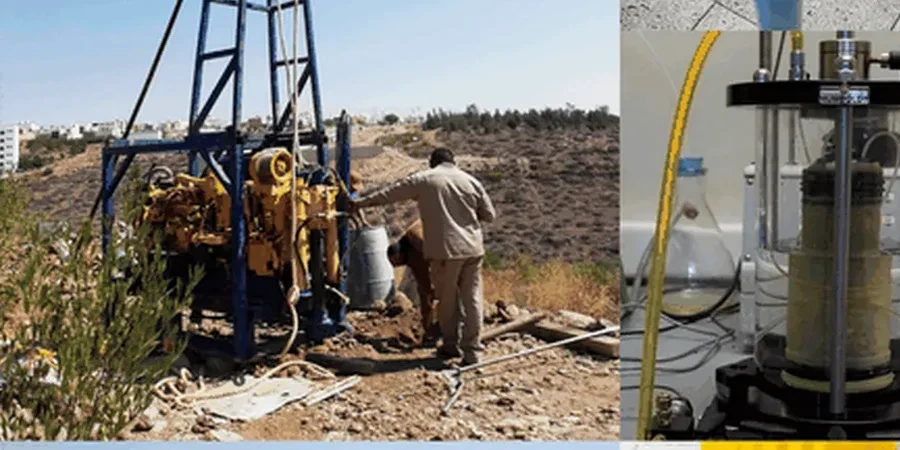
We mobilize a CME-75 rig across Ontario sites, performing standard penetration tests at 5-foot intervals with split-spoon recovery. Disturbed and undisturbed samples are transported under chain-of-custody to our lab for classification and strength testing.
Triaxial and direct shear strength suite
For Ontario projects requiring bearing capacity and slope stability calculations, we run consolidated-undrained triaxial with pore pressure measurement and direct shear on remolded samples compacted to field density, delivering c' and φ' for design.
Questions and answers
What does a soil mechanics study in Ontario California typically cost?
For a standard residential or light commercial lot in Ontario, a soil mechanics study usually ranges from US$2,700 to US$5,880, depending on the number of borings, lab tests required, and whether consolidation or triaxial testing is needed for the specific subsurface conditions encountered.
How deep do you drill for a soil mechanics study in Ontario?
We follow IBC Chapter 18 guidelines. For single-story structures, borings typically reach 15 to 20 feet. For multi-story or warehouse projects near the Ontario International Airport, we commonly extend to 30 or 40 feet to capture deeper alluvial layers and evaluate liquefaction susceptibility.
Which lab tests are mandatory for Ontario building permits?
The City of Ontario Building Department generally requires Atterberg limits, particle-size distribution per ASTM D2487, and direct shear or unconfined compression for bearing capacity verification. Expansive soil testing is mandatory in areas mapped with high clay content, particularly near the Chino basin edge.